A Descent into Limbo
Brian W. Kernighan
bwk@bell-labs.com
Revised April 2005 by Vita Nuova
ABSTRACT
‘‘If, reader, you are slow now to believe
What I shall tell, that is no cause for wonder,
For I who saw it hardly can accept it.’’
Dante Alighieri, Inferno, Canto XXV.
Limbo is a new programming language, designed by Sean Dorward, Phil Winterbottom, and Rob Pike. Limbo borrows from, among other things, C (expression syntax and control flow), Pascal (declarations), Winterbottom’s Alef (abstract data types and channels), and Hoare’s CSP and Pike’s Newsqueak (processes). Limbo is strongly typed, provides automatic garbage collection, supports only very restricted pointers, and compiles into machine-independent byte code for execution on a virtual machine.
This paper is a brief introduction to Limbo. Since Limbo is an integral part of the Inferno system, the examples here illustrate not only the language but also a certain amount about how to write programs to run within Inferno.
1. Introduction
This document is a quick look at the basics of Limbo; it is not a replacement for the reference manual. The first section is a short overview of concepts and constructs; subsequent sections illustrate the language with examples. Although Limbo is intended to be used in Inferno, which emphasizes networking and graphical interfaces, the discussion here begins with standard text-manipulation examples, since they require less background to understand.
Modules:
A Limbo program is a set of modules that cooperate to perform a task. In source form, a module consists of a module declaration that specifies the public interface - the functions, abstract data types, and constants that the module makes visible to other modules - and an implementation that provides the actual code. By convention, the module declaration is usually placed in a separate .m file so it can be included by other modules, and the implementation is stored in a .b file. Modules may have multiple implementations, each in a separate implementation file.
Modules are always loaded dynamically, at run time: the Limbo load operator fetches the code and performs run-time type checking. Once a module has been loaded, its functions can be called. Several instances of the same module type can be in use at once, with possibly different implementations.
Limbo is strongly typed; programs are checked at compile time, and further when modules are loaded. The Limbo compiler compiles each source file into a machine-independent byte-coded .dis file that can be loaded at run time.
Functions and variables:
Functions are associated with specific modules, either directly or as members of abstract data types within a module. Functions are visible outside their module only if they are part of the module interface. If the target module is loaded, specific names can be used in a qualified form like sys->print or without the qualifier if imported with an explicit import statement.
Besides normal block structure within functions, variables may have global scope within a module; module data can be accessed via the module pointer.
Data:
The numeric types are:
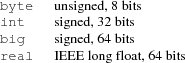
The size and signedness of integral types are as specified above, and will be the same everywhere. Character constants are enclosed in single quotes and may use escapes like ’\n’ or ’\udddd’, but the characters themselves are in Unicode and have type int. There is no enumeration type, but there is a con declaration that creates a named constant, and a special iota operation that can be used to generate unique values.
Limbo also provides Unicode strings, arrays of arbitrary types, lists of arbitrary types, tuples (in effect, unnamed structures with unnamed members of arbitrary types), abstract data types or adt’s (in effect, named structures with function members as well as data members), reference types (in effect, restricted pointers that can point only to adt objects), and typed channels (for passing objects between processes).
A channel is a mechanism for synchronized communication. It provides a place for one process to send or receive an object of a specific type; the attempt to send or receive blocks until a matching receive or send is attempted by another process. The alt statement selects randomly but fairly among channels that are ready to read or write. The spawn statement creates a new process that, except for its stack, shares memory with other processes. Processes are pre-emptively scheduled by the Inferno kernel. (Inferno processes are sometimes called ‘‘threads’’ in other operating systems.)
Limbo performs automatic garbage collection, so there is no need to free dynamically created objects. Objects are deleted and their resources freed when the last reference to them goes away. This release of resources happens immediately (‘‘instant free’’) for non-cyclic structures; release of cyclic data structures might be delayed but will happen eventually. (The language allows the programmer to ensure a given structure is non-cyclic when required.)
Operators and expressions:
Limbo provides many of C’s operators, but not the ?: or ‘comma’ (sequential execution) operators. Pointers, or ‘references’, created with ref, are restricted compared to C: they can only refer to adt values on the heap. There is no & (address of) operator, nor is address arithmetic possible. Arrays are also reference types, however, and since array slicing is supported, that replaces many of C’s pointer constructions.
There are no implicit coercions between types, and only a handful of explicit casts. The numeric types byte, int, etc., can be used to convert a numeric expression, as in
nl := byte 10;
and string can be used as a unary operator to convert any numeric expression to a string (in %g format) and to convert an array of bytes in UTF-8 format to a Limbo string value. In the other direction, the cast array of byte converts a string to its UTF-8 representation in an array of bytes.
Statements:
Statements and control flow in Limbo are similar to those in C. A statement is an expression followed by a semicolon, or a sequence of statements enclosed in braces. The similar control flow statements are
if (expr) stat
if (expr) stat else stat
while (expr) stat
for (expr; expr; expr) stat
do stat while (expr) ;
return expr ;
exit ;
The exit statement terminates a process and frees its resources. There is also a case statement analogous to C’s switch, but it differs in that it also supports string and range tests, and more critically, control flow does not ‘‘flow through’’ one arm of the case to another but stops without requiring an explicit break (in that respect it is closer to Pascal’s case statement, hence the change of name). A break or continue followed by a label causes a break out of, or the next iteration of, the enclosing construct that is labeled with the same label.
Comments begin with # and extend to the end of the line. There is no preprocessor, but an include statement can be used to include source code, usually module declaration files.
Libraries:
Limbo has an extensive and growing set of standard libraries, each implemented as a module. A handful of these (notably Sys, Draw, and Tk) are included in the Inferno kernel because they will be needed to support almost any Limbo program. Among the others are Bufio, a buffered I/O package based on Plan 9’s Bio; Regex, for regular expressions; and Math, for mathematical functions. Some of the examples that follow provide the sort of functionality that might be a suitable module.
2. Examples
The examples in this section are each complete, in the sense that they will run as presented; I have tried to avoid code fragments that merely illustrate syntax.
2.1. Hello, World
The first example is the traditional ‘‘hello, world’’, in the file hello.b:
implement Hello;
include "sys.m";
sys: Sys;
include "draw.m";
Hello: module
{
init: fn(ctxt: ref Draw->Context, args: list of string);
};
init(ctxt: ref Draw->Context, args: list of string)
{
sys = load Sys Sys->PATH;
sys->print("hello, world\n");
}
An implementation file implements a single module, named in the implement declaration at the top of the file. The two include lines copy interface definitions from two other modules, Sys (which describes a variety of system functions like print), and Draw (which describes a variety of graphics types and functions, only one of which, Context, is used here).
The module declaration defines the external interface that this module presents to the rest of the world. In this case, it’s a single function named init. Since this module is to be called from a command interpreter (shell), by convention its init function takes two arguments, the graphical context and a list of strings, the command-line arguments, though neither is used here. This is like main in a C program. Essentially all of the other examples begin with this standard code. Commands are unusual, though, in that a command’s module declaration appears in the same file as its implementation.
Most modules have a more extensive set of declarations; for example, draw.m is 298 lines of constants, function prototypes, and type declarations for graphics types like Point and Rect, and sys.m is 160 lines of declarations for functions like open, read, and print. Most module declarations are therefore stored in separate files, conventionally suffixed with .m, so they can be included in other modules. The system library module declaration files are collected in the module directory at the root of the Inferno source tree. Modules that are components of a single program are typically stored in that program’s source directory.
The last few lines of hello.b are the implementation of the init function, which loads the Sys module, then calls its print function. By convention, each module declaration includes a pathname constant that points to the code for the module; this is the second parameter Sys->PATH of the load statement. Note that the Draw module is not loaded because none of its functions is used, but it is included to define the type Draw->Context.
Compiling and Running Limbo Programs
With this much of the language described, we can compile and run this program. On Unix or Windows, the command
$ limbo -g hello.b
creates hello.dis, a byte-coded version of the program for the Dis virtual machine. The -g argument adds a symbol table, useful for subsequent debugging. (Another common option is -w, which causes the compiler to produce helpful warnings about possible errors.) The program can then be run as hello in Inferno; this shows execution under the Inferno emulator on a Unix system:
$ limbo -g hello.b
$ emu
; /usr/bwk/hello
hello, world
;
From within Inferno, it’s also possible to run a program by selecting it from a menu. In any case, as the program runs, it loads as necessary other modules that it uses.
2.2. A Graphical "Hello World"
The following module creates and displays a window containing only a button with the label ‘‘hello, world’’ as shown in the screen shot in Figure 1.
implement Hello2;
include "sys.m";
sys: Sys;
include "draw.m";
draw: Draw;
include "tk.m";
tk: Tk;
include "tkclient.m";
tkclient: Tkclient;
Hello2: module
{
init: fn(ctxt: ref Draw->Context, args: list of string);
};
init(ctxt: ref Draw->Context, args: list of string)
{
sys = load Sys Sys->PATH;
tk = load Tk Tk->PATH;
tkclient = load Tkclient Tkclient->PATH;
tkclient->init();
(t, nil) := tkclient->toplevel(ctxt, "", "Hello", Tkclient->Plain);
tk->cmd(t, "button .b -text {hello, world}");
tk->cmd(t, "pack .b");
tk->cmd(t, "update");
tkclient->onscreen(t, nil);
sys->sleep(10000); # wait 10 seconds
}
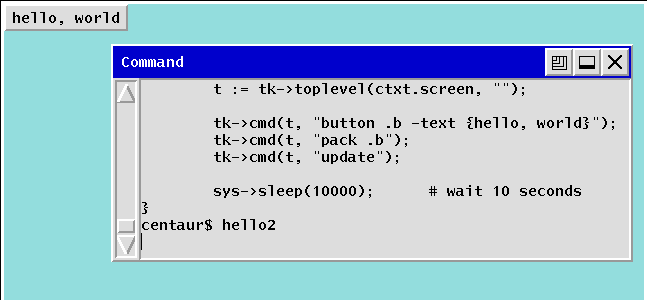
Figure 1. ‘Hello, world’ button.
This is not very exciting, but it illustrates the absolute minimum required to get a picture on the screen. The Tk module is modeled closely after John Ousterhout’s Tk interface toolkit, but Limbo is used as the programming language instead of Tcl. The Inferno version is similar in functionality to the original Tk but it does not support any Tcl constructs, such as variables, procedures, or expression evaluation, since all processing is done using Limbo. There are ten functions in the Tk interface, only one of which is used here: cmd, which executes a command string. (It is the most commonly used Tk function.)
Tk itself displays graphics and handles mouse and keyboard interaction within a window. There can however be many different windows on a display. A separate window manager, wm, multiplexes control of input and output among those windows. The module Tkclient provides the interface between the window manager and Tk. Its function toplevel, used above, makes a top-level window and returns a reference to it, for subsequent use by Tk. The contents of the window are prepared by calls to tk->cmd before the window is finally displayed by the call to onscreen. (The second parameter to onscreen, a string, controls the position and style of window; here we take the default by making that nil.)
Note that Tkclient must also be explicitly initialized by calling its init function after loading. This is a common convention, although some modules do not require it (typically those built in to the system, such as Sys or Tk).
The sleep delays exit for 10 seconds so the button can be seen. If you try to interact with the window, for instance by pressing the button, you will see no response. That is because the program has not done what is required to receive mouse or keyboard input in the window. In a real application, some action would also be bound to pressing the button. Such actions are handled by setting up a connection (a ‘channel’) from the Tk module to one’s own code, and processing the messages (‘events’) that appear on this channel. The Tk module and its interface to the window manager is explained in more detail later, as are a couple of other constructions, after we have introduced processes and channels.
2.3. Echo
The next example, echo, prints its command-line arguments. Declarations are the same as in the first example, and have been omitted.
# declarations omitted...
init(ctxt: ref Draw->Context, args: list of string)
{
sys = load Sys Sys->PATH;
args = tl args; # skip over program name
for (s := ""; args != nil; args = tl args)
s += " " + hd args;
if (s != "") # something was stored in s
sys->print("%s\n", s[1:]);
}
The arguments are stored in a list. Lists may be of any type; args is a list of string. There are three list operators: hd and tl return the head and tail of a list, and :: adds a new element to the head. In this example, the for loop walks along the args list until the end, printing the head element (hd args), then advancing (args = tl args).
The value nil is the ‘‘undefined’’ or ‘‘explicitly empty’’ value for non-numeric types.
The operator := combines the declaration of a variable and assignment of a value to it. The type of the variable on the left of := is the type of the expression on the right. Thus, the expression
s := ""
in the for statement declares a string s and initializes it to empty; if after the loop, s is not empty, something has been written in it. By the way, there is no distinction between the values nil and "" for strings.
The + and += operators concatenate strings. The expression s[1:] is a slice of the string s that starts at index 1 (the second character of the string) and goes to the end; this excludes the unwanted blank at the beginning of s.
2.4. Word Count
The word count program wc reads its standard input and counts the number of lines, words, and characters. Declarations have again been omitted.
# declarations omitted...
init(nil: ref Draw->Context, args: list of string)
{
sys = load Sys Sys->PATH;
buf := array[1] of byte;
stdin := sys->fildes(0);
OUT: con 0;
IN: con 1;
state := OUT;
nl := 0; nw := 0; nc := 0;
for (;;) {
n := sys->read(stdin, buf, 1);
if (n <= 0)
break;
c := int buf[0];
nc++;
if (c == ’\n’)
nl++;
if (c == ’ ’ || c == ’\t’ || c == ’\n’)
state = OUT;
else if (state == OUT) {
state = IN;
nw++;
}
}
sys->print("%d %d %d\n", nl, nw, nc);
}
This program contains several instances of the := operator. For example, the line
nl := 0; nw := 0; nc := 0;
declares three integer variables and assigns zero to each.
A Limbo program starts with three open files for standard input, standard output, and standard error, as in Unix. The line
stdin := sys->fildes(0);
declares a variable stdin and assigns the corresponding file descriptor to it. The type of stdin is whatever the type of sys->fildes(0) is, and it’s possible to get by without ever knowing the name of that type. (We will return to this shortly.)
The lines
OUT: con 0;
IN: con 1;
declare two integer constants with values zero and one. There is no enum type in Limbo; the con declaration is the closest equivalent. When the values are arbitrary, a different form is normally used:
OUT, IN: con iota;
The operator iota, when used in con declarations will produce the sequence of values 0, 1, ...., one value in turn for each name declared in the same declaration. It can appear in more complex expressions:
M1, M2, M4, M8: con 1 << iota;
N1, N3, N5, N7: con (2*iota)+1;
The first example generates a set of bitmask values; the second generates a sequence of odd numbers.
Given the declarations of IN and OUT, the line
state := OUT;
declares state to be an integer with initial value zero.
The line
buf := array[1] of byte;
declares buf to be a one-element array of bytes. Arrays are indexed from zero, so buf[0] is the only element. Arrays in Limbo are dynamic, so this array is created at the point of the declaration. An alternative would be to declare the array and create it in separate statements:
buf : array of byte; # no size at declaration
buf = array[1] of byte; # size needed at creation
Limbo does no automatic coercions between types, so an explicit coercion is required to convert the single byte read from stdin into an int that can be used in subsequent comparisons with int’s; this is done by the line
c := int buf[0];
which declares c and assigns the integer value of the input byte to it.
2.5. Word Count Version 2
The word count program above tacitly assumes that its input is in the ASCII subset of Unicode, since it reads input one byte at a time instead of one Unicode character at a time. If the input contains any multi-byte Unicode characters, this code is plain wrong. The assignment to c is a specific example: the integer value of the first byte of a multi-byte Unicode character is not the character.
There are several ways to address this shortcoming. Among the possibilities are rewriting to use the Bufio module, which does string I/O, or checking each input byte sequence to see if it is a multi-byte character. The second version of word counting uses Bufio. This example will also illustrate rules for accessing objects within modules.
# declarations omitted...
include "bufio.m";
bufio: Bufio;
Iobuf: import bufio;
init(nil: ref Draw->Context, nil: list of string)
{
sys = load Sys Sys->PATH;
bufio = load Bufio Bufio->PATH;
if (bufio == nil) {
sys->fprint(sys->fildes(2), "wc: can’t load %s: %r\n", Bufio->PATH);
raise "fail:load";
}
stdin := sys->fildes(0);
iob := bufio->fopen(stdin, bufio->OREAD);
if (iob == nil) {
sys->fprint(sys->fildes(2), "wc: can’t open stdin: %r\n");
raise "fail:open";
}
OUT, IN: con iota;
state := OUT;
nl := big 0; nw := big 0; nc := big 0;
for (;;) {
c := iob.getc();
if (c == Bufio->EOF)
break;
nc++;
if (c == ’\n’)
nl++;
if (c == ’ ’ || c == ’\t’ || c == ’\n’)
state = OUT;
else if (state == OUT) {
state = IN;
nw++;
}
}
sys->print("%bd %bd %bd\n", nl, nw, nc);
}
The lines
include "bufio.m";
bufio: Bufio;
include the declarations from bufio.m and declare a variable bufio that will serve as a handle when we load an implementation of the Bufio module. (The use of a module’s type in lower case as the name of a loaded instance is a common convention in Limbo programs.) With this handle, we can refer to the functions and types the module defines, which are in the file /usr/inferno/module/bufio.m (the full name might be different on your system). Parts of this declaration are shown here:
Bufio: module # edited to fit your screen
{
PATH: con "/dis/bufio.dis";
EOF: con -1;
Iobuf: adt {
fd: ref Sys->FD; # the file
buffer: array of byte; # the buffer
# other variables omitted
getc: fn(b: self ref Iobuf) : int;
gets: fn(b: self ref Iobuf, sep: int) : string;
close: fn(b: self ref Iobuf);
};
open: fn(name: string, mode: int) : ref Iobuf;
fopen: fn(fd: ref Sys->FD, mode: int) : ref Iobuf;
};
The bufio module defines open and fopen functions that return references to an Iobuf; this is much like a FILE* in the C standard I/O library. A reference is necessary so that all uses refer to the same entity, the object maintained by the module.
Given the name of a module (e.g., Bufio), how do we refer to its contents? It is always possible to use fully-qualified names, and the import statement permits certain abbreviations. We must also distinguish between the name of the module itself and a specific implementation returned by load, such as bufio.
The fully-qualified name of a type or constant from a module is
Modulename->name
as in Bufio->Iobuf or Bufio->EOF. To refer to members of an adt or functions or variables from a module, however, it is necessary to use a module value instead of a module name: although the interface is always the same, the implementations of different instances of a module will be different, and we must refer to a specific implementation. A fully-qualified name is
moduleval->functionname
moduleval->variablename
moduleval->adtname.membername
where adt members can be variables or functions. Thus:
iob: ref bufio->Iobuf;
bufio->open(...)
bufio->iob.getc()
bufio->iob.fd
It is also legal to refer to module types, constants, and variables with a module handle, as in bufio->EOF.
An import statement makes a specific list of names from a module accessible without need for a fully-qualified name. Each name must be imported explicitly, and adt member names can not be imported. Thus, the line
Iobuf: import bufio;
imports the adt name Iobuf, which means that functions within that adt (like getc) can be used without module qualification, i.e., without bufio->. (It is still necessary to say iob.getc() for reasons given below.) In all cases, imported names must be unique.
The second parameter of load is a string giving the location of the module implementation, typically a .dis file. (The string need not be static.) Some modules are part of the system; these have location names that begin with $ but are otherwise the same for users. By convention, modules include a constant called PATH that points to their default location.
The call to bufio->fopen attaches the I/O buffer to the already open file stdin; this is rather like freopen in stdio.
The function iob.getc returns the next Unicode character, or bufio->EOF if end of file was encountered.
A close look at the calls to sys->print shows a new format conversion character, %r, for which there is no corresponding argument in the expression list. The value of %r is the text of the most recent system error message.
Several other small changes were made as realistic examples: it keeps the counts as big to cope with larger files (hence the use of %bd as the output format); it prints diagnostics on the standard error stream, sys->fildes(2), using sys->fprint, a variant of sys->print that takes an explicit file descriptor; and it returns an error status to its caller (typically the shell) by raising an exception.
2.6. An Associative Array Module
This section describes a module that implements a conventional associative array (a hash table pointing to chained lists of name-value strings). This module is meant to be part of a larger program, not a standalone program like the previous examples.
The Hashtab module stores a name-value pair as a tuple of (string, string). A tuple is a type consisting of an ordered collection of objects, each with its own type. The hash table implementation uses several different tuples.
The hash table module defines a type to hold the data, using an adt declaration. An adt defines a type and optionally a set of functions that manipulate an object of that type. Since it provides only the ability to group variables and functions, it is like a really slimmed-down version of a C++ class, or a slightly fancier C struct. In particular, an adt does not provide information hiding (all member names are visible if the adt itself is visible), does not support inheritance, and has no constructors, destructors or overloaded method names. It is different from C or C++, however: when an adt is declared by a module declaration, the adt’s implementation (the bodies of its functions) will be defined by the module’s implementation, and there can be more than one. To create an instance of an adt,
adtvar := adtname(list of values for all members, in order);
adtvar := ref adtname(list of values for all members, in order);
Technically these are casts, from tuple to adt; that is, the adt is created from a tuple that specifies all of its members in order.
The Hashtab module contains an adt declaration for a type Table; the operations are a function alloc for initial allocation (in effect a constructor), a hash function, and methods to add and look up elements by name. Here is the module declaration, which is contained in file hashtab.m:
Hashtab: module
{
PATH: con "/usr/bwk/hashtab.dis"; # temporary name
Table: adt {
tab: array of list of (string, string);
alloc: fn(n: int) : ref Table;
hash: fn(ht: self ref Table, name: string) : int;
add: fn(ht: self ref Table, name: string, val: string);
lookup: fn(ht: self ref Table, name: string) : (int, string);
};
};
The implementation is in file hashtab.b:
implement Hashtab;
include "hashtab.m";
Table.alloc(n: int) : ref Table
{
return ref Table(array[n] of list of (string,string));
}
Table.hash(ht: self ref Table, s: string) : int
{
h := 0;
for (i := 0; i < len s; i++)
h = (h << 1) ^ int s[i];
h %= len ht.tab;
if (h < 0)
h += len ht.tab;
return h;
}
Table.add(ht: self ref Table, name: string, val: string)
{
h := ht.hash(name);
for (p := ht.tab[h]; p != nil; p = tl p) {
(tname, nil) := hd p;
if (tname == name) {
# illegal: hd p = (tname, val);
return;
}
}
ht.tab[h] = (name, val) :: ht.tab[h];
}
Table.lookup(ht: self ref Table, name: string) : (int, string)
{
h := ht.hash(name);
for (p := ht.tab[h]; p != nil; p = tl p) {
(tname, tval) := hd p;
if (tname == name)
return (1, tval);
}
return (0, "");
}
This is intentionally simple-minded, to focus on the language rather than efficiency or flexibility. The function Table.alloc creates and returns a Table with a specified size and an array of elements, each of which is a list of (string, string).
The hash function is trivial; the only interesting point is the len operator, which returns the number of items in a string, array or list. For a string, len s is the number of Unicode characters.
The self declaration says that the first argument of every call of this function is implicit, and refers to the value itself; this argument does not appear in the actual parameter list at any call site. Self is similar to this in C++.
The lookup function searches down the appropriate list for an instance of the name argument. If a match is found, lookup returns a tuple consisting of 1 and the value field; if no match is found, it returns a tuple of 0 and an empty string. These return types match the function return type, (int, string).
The line
(tname, tval) := hd p;
shows a tuple on the left side of a declaration-assignment. This splits the pair of strings referred to by hd p into components and assigns them to the newly declared variables tname and tval.
The add function is similar; it searches the right list for an instance of the name. If none is found,
ht.tab[h] = (name, val) :: ht.tab[h];
combines the name and value into a tuple, then uses :: to stick it on the front of the proper list.
The line
(tname, nil) := hd p;
in the loop body is a less obvious use of a tuple. In this case, only the first component, the name, is assigned, to a variable tname that is declared here. The other component is ‘‘assigned’’ to nil, which causes it to be ignored.
The line
# illegal: hd p = (tname, val);
is commented out because it’s illegal: Limbo does not permit the assignment of a new name-value to a list element; list elements are immutable.
To create a new Table, add some values, then retrieve one, we can write:
nvtab = Table.alloc(101); # make a Table
nvtab.add("Rob", "Pike");
nvtab.add("Howard", "Trickey");
(p, phil) := nvtab.lookup("Phil");
(q, sean) := nvtab.lookup("Sean");
Note that the ref Table argument does not appear in these calls; the self mechanism renders it unnecessary. Remember that a module using Table must import it from some instance of Hashtab, or qualify all references to it by a module value.
2.7. An AWK-like Input Module
This example presents a simple module based on Awk’s input mechanism: it reads input a line at a time from a list of of files, splits each line into an array of NF+1 strings (the original input line and the individual fields), and sets NF, NR, and FILENAME. It comes in the usual two parts, a module:
Awk: module
{
PATH: con "/usr/bwk/awk.dis";
init: fn(args: list of string);
getline: fn() : array of string;
NR: fn() : int;
NF: fn() : int;
FILENAME: fn() : string;
};
and an implementation:
implement Awk;
include "sys.m";
sys: Sys;
include "bufio.m";
bufio: Bufio;
Iobuf: import bufio;
iobuf: ref Iobuf;
include "awk.m";
_NR: int;
_NF: int;
_FILENAME: string;
args: list of string;
init(av: list of string)
{
args = tl av;
if (len args == 0) # no args => stdin
args = "-" :: nil;
sys = load Sys Sys->PATH;
bufio = load Bufio Bufio->PATH;
}
getline() : array of string
{
t := array[100] of string;
fl: list of string;
top:
while (args != nil) {
if (_FILENAME == nil) { # advance to next file
_FILENAME = hd args;
if (_FILENAME == "-")
iobuf = bufio->fopen(sys->fildes(0), bufio->OREAD);
else
iobuf = bufio->open(_FILENAME, bufio->OREAD);
if (iobuf == nil) {
sys->fprint(sys->fildes(2), "can’t open %s: %r\n", _FILENAME);
args = nil;
return nil;
}
}
s := iobuf.gets(’\n’);
if (s == nil) {
iobuf.close();
_FILENAME = nil;
args = tl args;
continue top;
}
t[0] = s[0:len s - 1];
_NR++;
(_NF, fl) = sys->tokenize(t[0], " \t\n\r");
for (i := 1; fl != nil; fl = tl fl)
t[i++] = hd fl;
return t[0:i];
}
return nil;
}
NR() : int { return _NR; }
NF() : int { return _NF; }
FILENAME() : string { return _FILENAME; }
Since NR, NF and FILENAME should not be modified by users, they are accessed as functions; the actual variables have related names like _NF. It would also be possible to make them ordinary variables in the Awk module, and refer to them via a module value (i.e., awk->NR).
The tokenize function in the line
(_NF, fl) = sys->tokenize(t[0], " \t\n\r");
breaks the argument string t[0] into tokens, as separated by the characters of the second argument. It returns a tuple consisting of a length and a list of tokens. Note that this module has an init function that must be called explicitly before any of its other functions are called.
2.8. A Simple Formatter
This program is a simple-minded text formatter, modeled after fmt, that tests the Awk module:
implement Fmt;
include "sys.m";
sys: Sys;
include "draw.m";
Fmt: module
{
init: fn(nil: ref Draw->Context, args: list of string);
};
include "awk.m";
awk: Awk;
getline, NF: import awk;
out: array of string;
nout: int;
length: int;
linelen := 65;
init(nil: ref Draw->Context, args: list of string)
{
t: array of string;
out = array[100] of string;
sys = load Sys Sys->PATH;
awk = load Awk Awk->PATH;
if (awk == nil) {
sys->fprint(sys->fildes(2), "fmt: can’t load %s: %r\n",
Awk->PATH);
raise "fail:load";
}
awk->init(args);
nout = 0;
length = 0;
while ((t = getline()) != nil) {
nf := NF();
if (nf == 0) {
printline();
sys->print("\n");
} else for (i := 1; i <= nf; i++) {
if (length + len t[i] > linelen)
printline();
out[nout++] = t[i];
length += len t[i] + 1;
}
}
printline();
}
printline()
{
if (nout == 0)
return;
for (i := 0; i < nout-1; i++)
sys->print("%s ", out[i]);
sys->print("%s\n", out[i]);
nout = 0;
length = 0;
}
The functions getline and NF have been imported so their names need no qualification. It is more usual Limbo style to use explicit references such as sys->read or Bufio->EOF for clarity, and import only adts (and perhaps commonly used constants).
2.9. Channels and Communications
Another approach to a formatter is to use one process to fetch words and pass them to another process that formats and prints them. This is easily done with a channel, as in this alternative version:
# declarations omitted...
WORD, BREAK, EOF: con iota;
wds: chan of (int, string);
init(nil: ref Draw->Context, nil: list of string)
{
sys = load Sys Sys->PATH;
bufio = load Bufio Bufio->PATH;
stdin := sys->fildes(0);
iob = bufio->fopen(stdin, bufio->OREAD);
wds = chan of (int, string);
spawn getword(wds);
putword(wds);
}
getword(wds: chan of (int, string))
{
while ((s := iob.gets(’\n’)) != nil) {
(n, fl) := sys->tokenize(s, " \t\n");
if (n == 0)
wds <-= (BREAK, "");
else for ( ; fl != nil; fl = tl fl)
wds <-= (WORD, hd fl);
}
wds <-= (EOF, "");
}
putword(wds: chan of (int, string))
{
for (length := 0;;) {
(wd, s) := <-wds;
case wd {
BREAK =>
sys->print("\n\n");
length = 0;
WORD =>
if (length + len s > 65) {
sys->print("\n");
length = 0;
}
sys->print("%s ", s);
length += len s + 1;
EOF =>
sys->print("\n");
exit;
}
}
}
This omits declarations and error checking in the interest of brevity.
The channel passes a tuple of (int, string); the int indicates what kind of string is present - a real word, a break caused by an empty input line, or EOF.
The spawn statement creates a separate process by calling the specified function; except for its own stack, this process shares memory with the process that spawned it. Any synchronization between processes is handled by channels.
The operator <-= sends an expression to a channel; the operator <- receives from a channel. (Receive is combined here with := to receive a tuple, and assign its elements to newly-declared variables.) In this example, getword and putword alternate, because each input word is sent immediately on the shared channel, and no subsequent word is processed until the previous one has been received and printed.
The case statement consists of a list of case values, which must be string or numeric constants, followed by => and associated code. The value * (not used here) labels the default. Multiple labels can be used, separated by the or operator, and ranges of values can appear delimited by to, as in
’a’ to ’z’ or ’A’ to ’Z’ =>
Remember that control does not flow from one case arm to the next, unlike C, thus no break statements appear.
2.10. Tk and Interface Construction
Inferno supports a rather complete implementation of the Tk interface toolkit developed by John Ousterhout. In other environments, Tk is normally accessed from Tcl programs, although there are also versions for Perl, Scheme and other languages that call Ousterhout’s C code. The Inferno Tk was implemented from scratch, and is meant to be called from Limbo programs. As we saw earlier, there is a module declaration tk.m and a kernel module Tk.
The Tk module provides all the widgets of the original Tk with almost all their options, the pack command for geometry management, and the bind command for attaching code to user actions. It also provides a grid command to simplify the common case of objects arranged in a matrix or grid. In this implementation Tk commands are written as strings and presented to one function, tk->cmd; Limbo calls this function and captures its return value, which is the string that the Tk command produces. For example, widget creation commands like button return the widget name, so this will be the string returned by tk->cmd.
There is one unconventional aspect: the use of channels to send data and events from the interface into the Limbo program. To create a widget, as we saw earlier, one writes
tk->cmd("button .b -text {Push me} -command {send cmd .bpush}");
to create a button .b and attach a command to be executed when the button is pushed. That command sends the (arbitrary) string .bpush on the channel named cmd. The Limbo code that reads from this channel will look for the string .bpush and act accordingly. The function tk->namechan establishes a correspondence between a Limbo channel value and a channel named as a string in the Tk module. When an event occurs in a Tk widget with a -command option, send causes the string to be sent on the channel and the Limbo code can act on it. The program will often use a case to process the strings that might appear on the channel, particularly when the same channel is used for several widgets.
We observed earlier that Tk provides a user interface for an application’s window, but there might be many windows on the screen. Normally, a graphical application is meant to run under the window manager wm as a window that can be managed, reshaped, etc. This is done by calling functions in the module Tkclient, which provides the interface between Tk and wm.
Several functions must be called to create a window, put it on the screen, and start giving it input. We have already seen Tkclient’s toplevel for window creation and onscreen to give a window space on the screen. Input arrives from several sources: from the mouse and keyboard, from the higher-level Tk widgets such as buttons, and from the window manager itself. In Limbo, each input source is represented by a channel, either given to the program by the window manager, or associated with one by namechan, as above.
This is all illustrated in the complete program below, which implements a trivial version of Etch-a-Sketch, shown in action in Figure 2.
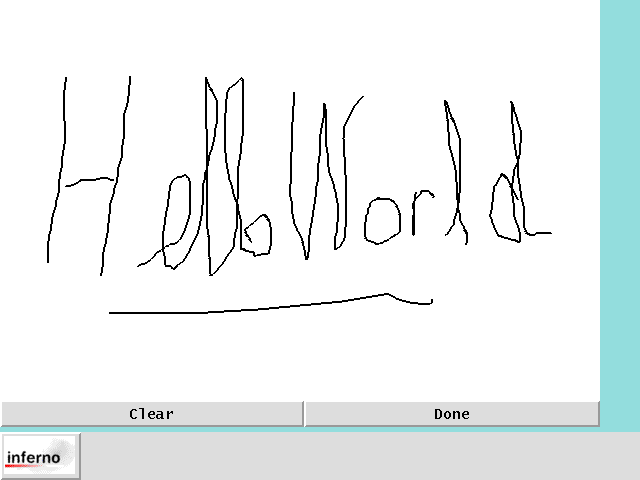
Figure 2. Etch-a-Sketch display.
implement Etch;
include "sys.m";
sys: Sys;
include "draw.m";
include "tk.m";
tk: Tk;
include "tkclient.m";
tkclient: Tkclient;
Etch: module
{
init: fn(ctxt: ref Draw->Context, args: list of string);
};
init(ctxt: ref Draw->Context, nil: list of string)
{
sys = load Sys Sys->PATH;
tk = load Tk Tk->PATH;
tkclient = load Tkclient Tkclient->PATH;
tkclient->init();
(t, winctl) := tkclient->toplevel(ctxt, nil, "Etch", Tkclient->Appl);
cmd := chan of string;
tk->namechan(t, cmd, "cmd");
tk->cmd(t, "canvas .c -height 400 -width 600 -background white");
tk->cmd(t, "frame .f");
tk->cmd(t, "button .f.c -text {Clear} -command {send cmd clear}");
tk->cmd(t, "button .f.d -text {Done} -command {send cmd quit}");
tk->cmd(t, "pack .f.c .f.d -side left -fill x -expand 1");
tk->cmd(t, "pack .c .f -side top -fill x");
tk->cmd(t, "bind .c <ButtonPress-1> {send cmd b1down %x %y}");
tk->cmd(t, "bind .c <Button-1-Motion> {send cmd b1motion %x %y}");
tk->cmd(t, "update");
tkclient->startinput(t, "ptr" :: "kbd" :: nil);
tkclient->onscreen(t, nil);
lastx, lasty: int;
for (;;) {
alt {
s := <-cmd =>
(nil, cmdstr) := sys->tokenize(s, " \t\n");
case hd cmdstr {
"quit" =>
exit;
"clear" =>
tk->cmd(t, ".c delete all; update");
"b1down" =>
lastx = int hd tl cmdstr;
lasty = int hd tl tl cmdstr;
cstr := sys->sprint(".c create line %d %d %d %d -width 2",
lastx, lasty, lastx, lasty);
tk->cmd(t, cstr);
"b1motion" =>
x := int hd tl cmdstr;
y := int hd tl tl cmdstr;
cstr := sys->sprint(".c create line %d %d %d %d -width 2",
lastx, lasty, x, y);
tk->cmd(t, cstr);
lastx = x; lasty = y;
}
p := <-t.ctxt.ptr =>
tk->pointer(t, *p);
c := <-t.ctxt.kbd =>
tk->keyboard(t, c);
ctl := <-winctl or
ctl = <-t.ctxt.ctl or
ctl = <-t.wreq =>
tkclient->wmctl(t, ctl);
}
tk->cmd(t, "update");
}
}
The function toplevel returns a tuple containing the Tk->Toplevel for the new window and a channel upon which the window manager will send messages for events such as hitting the exit button. An earlier example assigned the channel value to nil, discarding it; here it is assigned the name winctl. The parameters to toplevel includes a graphics context ctxt where the window will be created, a configuration string (simply nil here), the program name (which appears in the window’s ‘‘title bar’’ if it has one), and a value Tkclient->Appl that denotes a style of window suitable for most applications. Note that ctxt was one of the arguments to init. (We do not use the argument list for init, and so declare it as nil).
The program creates a canvas for drawing, a button to clear the canvas, and a button to quit. The sequence of calls to tk->cmd creates the picture and sets up the bindings. The buttons are created with a -command to send a suitable string on channel cmd, and two bind commands make the same channel the target for messages about mouse button presses and movement in the canvas. Note the %x and %y parameters in the latter case to include the mouse’s coordinates in the string.
The window manager sends keyboard and mouse input to the currently selected window using two more channels t.ctxt.kbd and t.ctxt.ptr. A further channel t.wreq is used by the Tk module itself to request changes to the window displaying Toplevel t.
Now there are many channels watching events: one for the buttons and canvas created by the drawing program itself, one for the mouse, and three for window management. We use an alt statement to select from events on any of those channels. The expression
s := <-cmd
declares a variable s of the type carried by the channel cmd, i.e., a string; when a string is received on the channel, the assignment is executed, and the subsequent case decodes the message. The channel t.ctxt.ptr carries references to Draw->Pointer values, which give the state and position of the pointing device (mouse or stylus). They are handed as received to tk->pointer for processing by Tk. Similarly, Unicode characters from the keyboard are given to Tk using tk->keyboard. Internally, Tk hands those values on to the various widgets for processing, possibly resulting in messages being sent on one of the other channels. Finally, a value received from any of the winctl, t.ctxt.ctl or t.wreq channels is passed back to Tkclient’s wmctl function to be handled there.
As another example, here is the startup code for an implementation of Othello, adapted from a Java version by Muffy Barkocy, Arthur van Hoff, and Ben Fry.
init(ctxt: ref Draw->Context, args: list of string)
{
sys = load Sys Sys->PATH;
tk = load Tk Tk->PATH;
tkclient = load Tkclient Tkclient->PATH;
sys->pctl(Sys->NEWPGRP, nil);
tkclient->init();
(t, winctl) := tkclient->toplevel(ctxt, nil, "Othello", Tkclient->Appl);
cmd := chan of string;
tk->namechan(t, cmd, "cmd");
tk->cmd(t, "canvas .c -height 400 -width 400 -background green");
tk->cmd(t, "frame .f");
tk->cmd(t, "label .f.l -text {Othello?} -background white");
tk->cmd(t, "button .f.c -text {Reset} -command {send cmd Reset}");
tk->cmd(t, "button .f.d -text {Quit} -command {send cmd Quit}");
tk->cmd(t, "pack .f.l .f.c .f.d -side left -fill x -expand 1");
tk->cmd(t, "pack .c .f -side top -fill x");
tk->cmd(t, "bind .c <ButtonRelease-1> {send cmd B1up %x %y}");
for (i := 1; i < 9; i++)
for (j := 1; j < 9; j++) {
coord := sys->sprint("%d %d %d %d",
SQ*i, SQ*j, SQ*(i+1), SQ*(j+1));
tk->cmd(t, ".c create rectangle " + coord +
" -outline black -width 2");
}
tk->cmd(t, "update");
lasterror(t, "init");
tkclient->startinput(t, "ptr" :: "kbd" :: nil);
tkclient->onscreen(t, nil);
board = array[10] of {* => array[10] of int};
score = array[10] of {* => array[10] of int};
reinit();
for (;;) {
alt {
s := <- cmd =>
(n, l) := sys->tokenize(s, " \t");
case hd l {
"Quit" =>
exit;
"Reset" =>
reinit();
"B1up" =>
x := int hd tl l;
y := int hd tl tl l;
mouseUp(int x, int y);
}
p := <-t.ctxt.ptr =>
tk->pointer(t, *p);
c := <-t.ctxt.kbd =>
tk->keyboard(t, c);
ctl := <-winctl or
ctl = <-t.ctxt.ctl or
ctl = <-t.wreq =>
tkclient->wmctl(t, ctl);
}
}
}
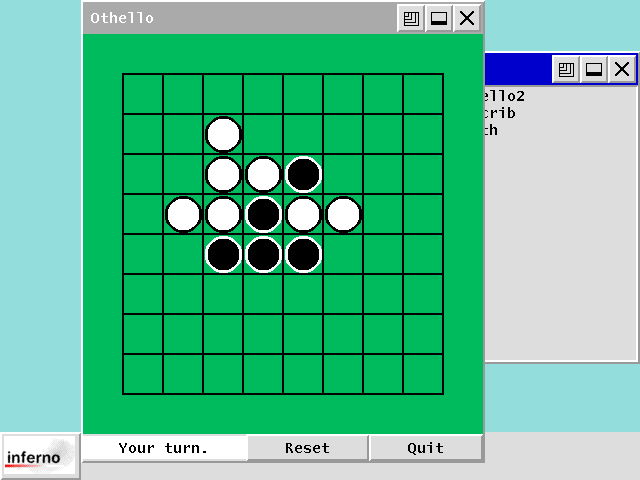
Figure 3. Screen shot of Inferno display showing Othello window.
If some call to the Tk module results in an error, an error string is made available in a pseudo-variable lasterror maintained by Tk. When this variable is read, it is reset. The function lasterror shows how to test and print this variable:
lasterror(t: ref Tk->Toplevel, where: string)
{
s := tk->cmd(t, "variable lasterror");
if (s != nil)
sys->print("%s: tk error %s\n", where, s);
}
In general, the Inferno implementation of Tk does not provide variables except for a few special ones like this. The most common instance is a variable that links a set of radiobuttons.
2.11. Acknowledgements
I am very grateful to Steven Breitstein, Ken Clarkson, Sean Dorward, Eric Grosse, Doug McIlroy, Rob Pike, Jon Riecke, Dennis Ritchie, Howard Trickey, Phil Winterbottom, and Margaret Wright for explaining mysteries of Limbo and Inferno and for valuable suggestions on this paper.