Dis Virtual Machine Specification
Lucent Technologies Inc
30 September 1999
Extensively revised by Vita Nuova Limited
5 June 2000, 9 January 2003
1. Introduction
The Dis virtual machine provides the execution environment for programs running under the Inferno operating system. The virtual machine models a CISC-like, three operand, memory-to-memory architecture. Code can either be interpreted by a C library or compiled on-the-fly into machine code for the target architecture.
This paper defines the virtual machine informally. A separate paper by Winterbottom and Pike[2] discusses its design. The Dis object file format is also defined here. Literals and keywords are in typewriter typeface.
2. Addressing Modes
Operand Size
Operand sizes are defined as follows: a byte is 8 bits, a word or pointer is 32 bits, a float is 64 bits, a big integer is 64 bits. The operand size of each instruction is encoded explicitly by the operand code. The operand size and type are specified by the last character of the instruction mnemonic:
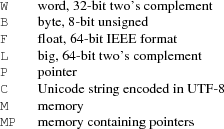
Two more operand types are defined to provide ‘short’ types for use by languages other than Limbo: signed 16-bit integers, called ‘short word’ here, and 32-bit IEEE format floating-point numbers, called ‘short float’ or ‘short real’ here. Support for them is limited to conversion to and from words or floats respectively; the instructions are marked below with a dagger (†).
Memory Organization
Memory for a thread is divided into several separate regions. The code segment stores either a decoded virtual machine instruction stream suitable for execution by the interpreter or flash compiled native machine code for the host CPU. Neither type of code segment is addressable from the instruction set. At the object code level, PC values are offsets, counted in instructions, from the beginning of the code space.
Data memory is a linear array of bytes, addressed using 32-bit pointers. Words are stored in the native representation of the host CPU. Data types larger than a byte must be stored at addresses aligned to a multiple of the data size. A thread executing a module has access to two regions of addressable data memory. A module pointer (mp register) defines a region of global storage for a particular module, a frame pointer (fp register) defines the current activation record or frame for the thread. Frames are allocated dynamically from a stack by function call and return instructions. The stack is extended automatically from the heap.
The mp and fp registers cannot be addressed directly, and therefore, can be modified only by call and return instructions.
Effective Addresses
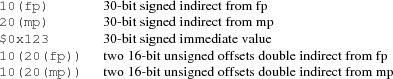
Each instruction can potentially address three operands. The source and destination operands are general, but the middle operand can use any address mode except double indirect. If the middle operand of a three address instruction is omitted, it is assumed to be the same as the destination operand.
The general operands generate an effective address from three basic modes: immediate, indirect and double indirect. The assembler syntax for each mode is:
Garbage Collection
The Dis machine performs both reference counted and real time mark and sweep garbage collection. This hyrbrid approach allows code to be generated in several styles: pure reference counted, mark and sweep, or a hybrid of the two approaches. Compiler writers have the freedom to choose how specific types are handled by the machine to optimize code for performance or language implementation. Instruction selection determines which algorithm will be applied to specific types.
When using reference counting, pointers are a special operand type and should only be manipulated using the pointer instructions in order to ensure the correct functioning of the garbage collector. Every memory location that stores a pointer must be known to the interpreter so that it can be initialized and deallocated correctly. The information is transmitted in the form of type descriptors in the object module. Each type descriptor contains a bit vector for a particular type where each bit corresponds to a word in memory. Type descriptors are generated automatically by the Limbo compiler. The assembler syntax for a type descriptor is:
desc $10, 132, "001F"
The first parameter is the descriptor number, the second is the size in bytes, and the third a pointer map. The map contains a list of hex bytes where each byte maps eight 32 bit words. The most significant bit represents the lowest memory address. A one bit indicates a pointer in memory. The map need not have an entry for every byte and unspecified bytes are assumed zero.
Throughout this description, the symbolic constant H refers to a nil pointer.
3. Instruction Set
addx - Add
Syntax: addb src1, src2, dst
addf src1, src2, dst
addw src1, src2, dst
addl src1, src2, dst
Function: dst = src1 + src2
The add instructions compute the sum of the operands addressed by src1 and src2 and stores the result in the dst operand. For addb the result is truncated to eight bits.
addc - Add strings
Syntax: addc src1, src2, dst
Function: dst = src1 + src2
The addc instruction concatenates the two UTF strings pointed to by src1 and src2; the result is placed in the pointer addressed by dst. If both pointers are H the result will be a zero length string rather than H.
alt - Alternate between communications
Syntax: alt src, dst
The alt instruction selects between a set of channels ready to communicate. The src argument is the address of a structure of the following form:
struct Alt {
int nsend; /* Number of senders */
int nrecv; /* Number of receivers */
struct {
Channel* c; /* Channel */
void* val; /* Address of lval/rval */
} entry[];
};
The vector is divided into two sections; the first lists the channels ready to send values, the second lists channels either ready to receive or an array of channels each of which may be ready to receive. The counts of the sender and receiver channels are stored as the first and second words addressed by src. An alt instruction proceeds by testing each channel for readiness to communicate. A ready channel is added to a list. If the list is empty after each channel has been considered, the thread blocks at the alt instruction waiting for a channel to become ready; otherwise, a channel is picked at random from the ready set.
The alt instruction then uses the selected channel to perform the communication using the val address as either a source for send or a destination for receive. The numeric index of the selected vector element is placed in dst.
andx - Logical AND
Syntax: andb src1, src2, dst
andw src1, src2, dst
andl src1, src2, dst
Function: dst = src1 & src2
The instructions compute the bitwise AND of the two operands addressed by src1 and src2 and stores the result in the dst operand.
beqx - Branch equal
Syntax: beqb src1, src2, dst
beqc src1, src2, dst
beqf src1, src2, dst
beqw src1, src2, dst
beql src1, src2, dst
Function: if src1 == src2 then pc = dst
If the src1 operand is equal to the src2 operand, then control is transferred to the program counter specified by the dst operand.
bgex - Branch greater or equal
Syntax: bgeb src1, src2, dst
bgec src1, src2, dst
bgef src1, src2, dst
bgew src1, src2, dst
bgel src1, src2, dst
Function: if src1 >= src2 then pc = dst
If the src1 operand is greater than or equal to the src2 operand, then control is transferred to program counter specified by the dst operand. This instruction performs a signed comparison.
bgtx - Branch greater
Syntax: bgtb src1, src2, dst
bgtc src1, src2, dst
bgtf src1, src2, dst
bgtw src1, src2, dst
bgtl src1, src2, dst
Function: if src1 > src2 then pc = dst
If the src1 operand is greater than the src2 operand, then control is transferred to the program counter specified by the dst operand. This instruction performs a signed comparison.
blex - Branch less than or equal
Syntax: bleb src1, src2, dst
blec src1, src2, dst
blef src1, src2, dst
blew src1, src2, dst
blel src1, src2, dst
Function: if src1 <= src2 then pc = dst
If the src1 operand is less than or equal to the src2 operand, then control is transferred to the program counter specified by the dst operand. This instruction performs a signed comparison.
bltx - Branch less than
Syntax: bltb src1, src2, dst
bltc src1, src2, dst
bltf src1, src2, dst
bltw src1, src2, dst
bltl src1, src2, dst
Function: if src1 < src2 then pc = dst
If the src1 operand is less than the src2 operand, then control is transferred to the program counter specified by the dst operand.
bnex - Branch not equal
Syntax: bneb src1, src2, dst
bnec src1, src2, dst
bnef src1, src2, dst
bnew src1, src2, dst
bnel src1, src2, dst
Function: if src1 != src2 then pc = dst
If the src1 operand is not equal to the src2 operand, then control is transferred to the program counter specified by the dst operand.
call - Call local function
Syntax: call src, dst
Function: link(src) = pc
frame(src) = fp
mod(src) = 0
fp = src
pc = dst
The call instruction performs a function call to a routine in the same module. The src argument specifies a frame created by new. The current value of pc is stored in link(src), the current value of fp is stored in frame(src) and the module link register is set to 0. The value of fp is then set to src and control is transferred to the program counter specified by dst.
case - Case compare integer and branch
Syntax: case src, dst
Function: pc = 0..i: dst[i].pc where
dst[i].lo >= src && dst[i].hi < src
The case instruction jumps to a new location specified by a range of values. The dst operand points to a table in memory containing a table of i values. Each value is three words long: the first word specifies a low value, the second word specifies a high value, and the third word specifies a program counter. The first word of the table gives the number of entries. The case instruction searches the table for the first matching value where the src operand is greater than or equal to the low word and less than the high word. Control is transferred to the program counter stored in the first word of the matching entry.
casec - Case compare string and branch
Syntax: casec src, dst
Function: pc = 0..i: dst[i].pc where
dst[i].lo >= src && dst[i].hi < src
The casec instruction jumps to a new location specified by a range of string constants. The table is the same as described for the case instruction.
consx - Allocate new list element
Syntax: consb src, dst
consc src, dst
consf src, dst
consl src, dst
consm src, dst
consmp src, dst
consp src, dst
consw src, dst
Function: p = new(src, dst)
dst = p
The cons instructions add a new element to the head of a list. A new list element is composed from the src operand and a pointer to the head of an extant list specified by dst. The resulting element is stored back into dst.
cvtac - Convert byte array to string
Syntax: cvtac src, dst
Function: dst = string(src)
The src operand must be an array of bytes, which is converted into a character string and stored in dst. The new string is a copy of the bytes in src.
cvtbw - Convert byte to word
Syntax: cvtbw src, dst
Function: dst = src & 0xff
A byte is fetched from the src operand extended to the size of a word and then stored into dst.
cvtca - Convert string to byte array
Syntax: cvtca src, dst
Function: dst = array(src)
The src operand must be a string which is converted into an array of bytes and stored in dst. The new array is a copy of the characters in src.
cvtcf - Convert string to real
Syntax: cvtcf src, dst
Function: dst = (float)src
The string addressed by the src operand is converted to a floating point value and stored in the dst operand. Initial white space is ignored; conversion ceases at the first character in the string that is not part of the representation of the floating point value.
cvtcl - Convert string to big
Syntax: cvtcl src, dst
Function: dst = (big)src
The string addressed by the src operand is converted to a big integer and stored in the dst operand. Initial white space is ignored; conversion ceases at the first non-digit in the string.
cvtcw - Convert string to word
Syntax: cvtcw src, dst
Function: dst = (int)src
The string addressed by the src operand is converted to a word and stored in the dst operand. Initial white space is ignored; after a possible sign, conversion ceases at the first non-digit in the string.
cvtfc - Convert real to string
Syntax: cvtfc src, dst
Function: dst = string(src)
The floating point value addressed by the src operand is converted to a string and stored in the dst operand. The string is a floating point representation of the value.
cvtfw - Convert real to word
Syntax: cvtfw src, dst
Function: dst = (int)src
The floating point value addressed by src is converted into a word and stored into dst. The floating point value is rounded to the nearest integer.
cvtfl - Convert real to big
Syntax: cvtfl src, dst
Function: dst = (big)src
The floating point value addressed by src is converted into a big integer and stored into dst. The floating point value is rounded to the nearest integer.
cvtfr - Convert real to short real†
Syntax: cvtfr src, dst
Function: dst = (short float)src
The floating point value addressed by src is converted to a short (32-bit) floating point value and stored into dst. The floating point value is rounded to the nearest integer.
cvtlc - Convert big to string
Syntax: cvtlc src, dst
Function: dst = string(src)
The big integer addressed by the src operand is converted to a string and stored in the dst operand. The string is the decimal representation of the big integer.
cvtlw - Convert big to word
Syntax: cvtlw src, dst
Function: dst = (int)src
The big integer addressed by the src operand is converted to a word and stored in the dst operand.
cvtsw - Convert short word to word†
Syntax: cvtsw src, dst
Function: dst = (int)src
The short word addressed by the src operand is converted to a word and stored in the dst operand.
cvtwb - Convert word to byte
Syntax: cvtwb src, dst
Function: dst = (byte)src;
The src operand is converted to a byte and stored in the dst operand.
cvtwc - Convert word to string
Syntax: cvtwc src, dst
Function: dst = string(src)
The word addressed by the src operand is converted to a string and stored in the dst operand. The string is the decimal representation of the word.
cvtwl - Convert word to big
Syntax: cvtwl src, dst
Function: dst = (big)src;
The word addressed by the src operand is converted to a big integer and stored in the dst operand.
cvtwf - Convert word to real
Syntax: cvtwf src, dst
Function: dst = (float)src;
The word addressed by the src operand is converted to a floating point value and stored in the dst operand.
cvtws - Convert word to short word†
Syntax: cvtws src, dst
Function: dst = (short)src;
The word addressed by the src operand is converted to a short word and stored in the dst operand.
cvtlf - Convert big to real
Syntax: cvtlf src, dst
Function: dst = (float)src;
The big integer addressed by the src operand is converted to a floating point value and stored in the dst operand.
cvtrf - Convert short real to real†
Syntax: cvtrf src, dst
Function: dst = (float)src;
The short (32 bit) floating point value addressed by the src operand is converted to a 64-bit floating point value and stored in the dst operand.
divx - Divide
Syntax: divb src1, src2, dst
divf src1, src2, dst
divw src1, src2, dst
divl src1, src2, dst
Function: dst = src2/src1
The src2 operand is divided by the src1 operand and the quotient is stored in the dst operand. Division by zero causes the thread to terminate.
exit - Terminate thread
Syntax: exit
Function: exit()
The executing thread terminates. All resources held in the stack are deallocated.
frame - Allocate frame for local call
Syntax: frame src1, src2
Function: src2 = fp + src1->size
initmem(src2, src1);
The frame instruction creates a new stack frame for a call to a function in the same module. The frame is initialized according to the type descriptor supplied as the src1 operand. A pointer to the newly created frame is stored in the src2 operand.
goto - Computed goto
Syntax: goto src, dst
Function: pc = dst[src]
The goto instruction performs a computed goto. The src operand must be an integer index into a table of PC values specified by the dst operand.
headx - Head of list
Syntax: headb src, dst
headf src, dst
headm src, dst
headmp src, dst
headp src, dst
headw src, dst
headl src, dst
Function: dst = hd src
The head instructions make a copy of the first data item stored in a list. The src operand must be a list of the correct type. The first item is copied into the dst operand. The list is not modified.
indc - Index by character
Syntax: indc src1, src2, dst
Function: dst = src1[src2]
The indc instruction indexes Unicode strings. The src1 instruction must be a string. The src2 operand must be an integer specifying the origin-0 index in src1 of the (Unicode) character to store in the dst operand.
indx - Array index
Syntax: indx src1, dst, src2
Function: dst = &src1[src2]
The indx instruction computes the effective address of an array element. The src1 operand must be an array created by the newa instruction. The src2 operand must be an integer. The effective address of the src2 element of the array is stored in the dst operand.
indx - Index by type
Syntax: indb src1, dst, src2
indw src1, dst, src2
indf src1, dst, src2
indl src1, dst, src2
Function: dst = src1[src2]
The indb, indw, indf and indl instructions index arrays of the basic types. The src1 operand must be an array created by the newa instruction. The src2 operand must be a non-negative integer index less than the array size. The value of the element at the index is loaded into the dst operand.
insc - Insert character into string
Syntax: insc src1, src2, dst
Function: src1[src2] = dst
The insc instruction inserts a character into an existing string. The index in src2 must be a non-negative integer less than the length of the string plus one. (The character will be appended to the string if the index is equal to the string’s length.) The src1 operand must be a string (or nil). The character to insert must be a valid 16-bit unicode value represented as a word.
jmp - Branch always
Syntax: jmp dst
Function: pc = dst
Control is transferred to the location specified by the dst operand.
lea - Load effective address
Syntax: lea src, dst
Function: dst = &src
The lea instruction computes the effective address of the src operand and stores it in the dst operand.
lena - Length of array
Syntax: lena src, dst
Function: dst = nelem(src)
The lena instruction computes the length of the array specified by the src operand and stores it in the dst operand.
lenc - Length of string
Syntax: lenc src, dst
Function: dst = utflen(src)
The lenc instruction computes the number of characters in the UTF string addressed by the src operand and stores it in the dst operand.
lenl - Length of list
Syntax: lenl src, dst
Function: dst = 0;
for(l = src; l; l = tl l)
dst++;
The lenl instruction computes the number of elements in the list addressed by the src operand and stores the result in the dst operand.
load - Load module
Syntax: load src1, src2, dst
Function: dst = load src2 src1
The load instruction loads a new module into the heap. The module might optionally be compiled into machine code depending on the module header. The src1 operand is a pathname to the file containing the object code for the module. The src2 operand specifies the address of a linkage descriptor for the module (see below). A reference to the newly loaded module is stored in the dst operand. If the module could not be loaded for any reason, then dst will be set to H.
The linkage descriptor referenced by the src2 operand is a table in data space that lists the functions imported by the current module from the module to be loaded. It has the following layout:
int nentries;
struct { /* word aligned */
int sig;
byte name[]; /* UTF encoded name, 0-terminated */
} entry[];
The nentries value gives the number of entries in the table and can be zero. It is followed by that many linkage entries. Each entry is aligned on a word boundary; there can therefore be padding before each structure. The entry names the imported function in the UTF-encoded string in name, which is terminated by a byte containing zero. The MD5 hash of the function’s type signature is given in the value sig. For each entry, load instruction checks that a function with the same name in the newly loaded exists, with the same signature. Otherwise the load will fail and dst will be set to H.
The entries in the linkage descriptor form an array of linkage records (internal to the virtual machine) associated with the module pointer returned in dst, that is indexed by operators mframe, mcall and mspawn to refer to functions in that module. The linkage scheme provides a level of indirection that allows a module to be loaded using any module declaration that is a valid subset of the implementation module’s declaration, and allows entry points to be added to modules without invalidating calling modules.
lsrx - Logical shift right
Syntax: lsrw src1, src2, dst
lsrl src1, src2, dst
Function: dst = (unsigned)src2 >> src1
The lsr instructions shift the src2 operand right by the number of bits specified by the src1 operand, replacing the vacated bits by 0, and store the result in the dst operand. Shift counts less than 0 or greater than the number of bits in the object have undefined results. This instruction is included for support of languages other than Limbo, and is not used by the Limbo compiler.
mcall - Inter-module call
Syntax: mcall src1, src2, src3
Function: link(src1) = pc
frame(src1) = fp
mod(src1) = current_moduleptr
current_moduleptr = src3->moduleptr
fp = src1
pc = src3->links[src2]->pc
The mcall instruction calls a function in another module. The first argument specifies a new frame for the called procedure and must have been built using the mframe instruction. The src3 operand is a module reference generated by a successful load instruction. The src2 operand specifies the index for the called function in the array of linkage records associated with that module reference (see the load instruction).
mframe - Allocate inter-module frame
Syntax: mframe src1, src2, dst
Function: dst = fp + src1->links[src2]->t->size
initmem(dst, src1->links[src2])
The mframe instruction allocates a new frame for a procedure call into another module. The src1 operand specifies the location of a module pointer created as the result of a successful load instruction. The src2 operand specifies the index for the called function in the array of linkage records associated with that module pointer (see the load instruction). A pointer to the initialized frame is stored in dst. The src2 operand specifies the linkage number of the function to be called in the module specified by src1.
mnewz - Allocate object given type from another module
Syntax: mnewz src1, src2, dst
Function: dst = malloc(src1->types[src2]->size)
initmem(dst, src1->types[src2]->map)
The mnewz instruction allocates and initializes storage to a new area of memory. The src1 operand specifies the location of a module pointer created as the result of a successful load instruction. The size of the new memory area and the location of pointers within it are specified by the src2 operand, which gives a type descriptor number within that module. Space not occupied by pointers is initialized to zero. A pointer to the initialized object is stored in dst. This instruction is not used by Limbo; it was added to implement other languages.
modx - Modulus
Syntax: modb src1, src2, dst
modw src1, src2, dst
modl src1, src2, dst
Function: dst = src2 % src1
The modulus instructions compute the remainder of the src2 operand divided by the src1 operand and store the result in dst. The operator preserves the condition that the absolute value of a%b is less than the absolute value of b; (a/b)*b + a%b is always equal to a.
movx - Move scalar
Syntax: movb src, dst
movw src, dst
movf src, dst
movl src, dst
Function: dst = src
The move operators perform assignment. The value specified by the src operand is copied to the dst operand.
movm - Move memory
Syntax: movm src1, src2, dst
Function: memmove(&dst, &src1, src2)
The movm instruction copies memory from the src1 operand to the dst operand for src2 bytes. The src1 and dst operands specify the effective address of the memory rather than a pointer to the memory.
movmp - Move memory and update reference counts
Syntax: movmp src1, src2, dst
Function: decmem(&dst, src2)
memmove(&dst, &src1, src2->size)
incmem(&src, src2)
The movmp instructions performs the same function as the movm instruction but increments the reference count of pointers contained in the data type. For each pointer specified by the src2 type descriptor, the corresponding pointer reference count in the destination is decremented. The movmp instruction then copies memory from the src1 operand to the dst operand for the number of bytes described by the type descriptor. For each pointer specified by the type descriptor the corresponding pointer reference count in the source is incremented.
movp - Move pointer
Syntax: movp src, dst
Function: destroy(dst)
dst = src
incref(src)
The movp instruction copies a pointer adjusting the reference counts to reflect the new pointers.
movpc - Move program counter
Syntax: movpc src, dst
Function: dst = PC(src);
The movpc instruction computes the actual address of an immediate PC value. The dst operand is set to the actual machine address of the instruction addressed by the src operand. This instruction must be used to calculate PC values for computed branches.
mspawn - Module spawn function
Syntax: mspawn src1, src2, src3
Function: fork();
if(child){
link(src1) = 0
frame(src1) = 0
mod(src1) = src3->moduleptr
current_moduleptr = src3->moduleptr
fp = src1
pc = src3->links[src2]->pc
}
The mspawn instruction creates a new thread, which starts executing a function in another module. The first argument specifies a new frame for the called procedure and must have been built using the mframe instruction. The src3 operand is a module reference generated by a successful load instruction. The src2 operand specifies the index for the called function in the array of linkage records associated with that module reference (see the load instruction above).
mulx - Multiply
Syntax: mulb src1, src2, dst
mulw src1, src2, dst
mulf src1, src2, dst
mull src1, src2, dst
Function: dst = src1 * src2
The src1 operand is multiplied by the src2 operand and the product is stored in the dst operand.
nbalt - Non blocking alternate
Syntax: nbalt src, dst
The nbalt instruction has the same operands and function as alt , except that if no channel is ready to communicate, the instruction does not block. When no channels are ready, control is transferred to the PC in the last element of the table addressed by dst.
negf - Negate real
Syntax: negf src, dst
Function: dst = -src
The floating point value addressed by the src operand is negated and stored in the dst operand.
new, newz - Allocate object
Syntax: new src, dst
newz src, dst
Function: dst = malloc(src->size);
initmem(dst, src->map);
The new instruction allocates and initializes storage to a new area of memory. The size and locations of pointers are specified by the type descriptor number given as the src operand. A pointer to the newly allocated object is placed in dst. Any space not occupied by pointers has undefined value.
The newz instruction additionally guarantees that all non-pointer values are set to zero. It is not used by Limbo.
newa, newaz - Allocate array
Syntax: newa src1, src2, dst
newaz src1, src2, dst
Function: dst = malloc(src2->size * src1);
for(i = 0; i < src1; i++)
initmem(dst + i*src2->size, src2->map);
The newa instruction allocates and initializes an array. The number of elements is specified by the src1 operand. The type of each element is specified by the type descriptor number given as the src2 operand. Space not occupied by pointers has undefined value. The newaz instruction additionally guarantees that all non-pointer values are set to zero; it is not used by Limbo.
newcx - Allocate channel
Syntax: newcw dst
newcb dst
newcl dst
newcf dst
newcp dst
newcm src, dst
newcmp src, dst
Function: dst = new(Channel)
The newc instruction allocates a new channel of the specified type and stores a reference to the channel in dst. For the newcm instruction the source specifies the number of bytes of memory used by values sent on the channel (see the movm instruction above). For the newcmp instruction the first operand specifies a type descriptor giving the length of the structure and the location of pointers within the structure (see the movmp instruction above).
orx - Logical OR
Syntax: orb src1, src2, dst
orw src1, src2, dst
orl src1, src2, dst
Function: dst = src1 | src
These instructions compute the bitwise OR of the two operands addressed by src1 and src2 and store the result in the dst operand.
recv - Receive from channel
Syntax: recv src, dst
Function: dst = <-src
The recv instruction receives a value from some other thread on the channel specified by the src operand. Communication is synchronous, so the calling thread will block until a corresponding send or alt is performed on the channel. The type of the received value is determined by the channel type and the dst operand specifies where to place the received value.
ret - Return from function
Syntax: ret
Function: npc = link(fp)
mod = mod(fp)
fp = frame(fp)
pc = npc
The ret instruction returns control to the instruction after the call of the current function.
send - Send to channel
Syntax: send src, dst
Function: dst <-= src
The send instruction sends a value from this thread to some other thread on the channel specified by the dst operand. Communication is synchronous so the calling thread will block until a corresponding recv or alt is performed on the channel. The type of the sent value is determined by the channel type and the dst operand specifies where to retrieve the sent value.
shlx - Shift left arithmetic
Syntax: shlb src1, src2, dst
shlw src1, src2, dst
shll src1, src2, dst
Function: dst = src2 << src1
The shl instructions shift the src2 operand left by the number of bits specified by the src1 operand and store the result in the dst operand. Shift counts less than 0 or greater than the number of bits in the object have undefined results.
shrx - Shift right arithmetic
Syntax: shrb src1, src2, dst
shrw src1, src2, dst
shrl src1, src2, dst
Function: dst = src2 >> src1
The shr instructions shift the src2 operand right by the number of bits specified by the src1 operand and store the result in the dst operand. Shift counts less than 0 or greater than the number of bits in the object have undefined results.
slicea - Slice array
Syntax: slicea src1, src2, dst
Function: dst = dst[src1:src2]
The slicea instruction creates a new array, which contains the elements from the index at src1 to the index src2-1. The new array is a reference array which points at the elements in the initial array. The initial array will remain allocated until both arrays are no longer referenced.
slicec - Slice string
Syntax: slicec src1, src2, dst
Function: dst = dst[src1:src2]
The slicec instruction creates a new string, which contains characters from the index at src1 to the index src2-1. Unlike slicea , the new string is a copy of the elements from the initial string.
slicela - Assign to array slice
Syntax: slicela src1, src2, dst
Function: dst[src2:] = src1
The src1 and dst operands must be arrays of equal types. The src2 operand is a non-negative integer index. The src1 array is assigned to the array slice dst[src2:]; src2 + nelem(src1) must not exceed nelem(dst).
spawn - Spawn function
Syntax: spawn src, dst
Function: fork();
if(child)
dst(src);
The spawn instruction creates a new thread and calls the function specified by the dst operand. The argument frame passed to the thread function is specified by the src operand and should have been created by the frame instruction.
subx - Subtract
Syntax: subb src1, src2, dst
subf src1, src2, dst
subw src1, src2, dst
subl src1, src2, dst
Function: dst = src2 - src1
The sub instructions subtract the operands addressed by src1 and src2 and stores the result in the dst operand. For subb, the result is truncated to eight bits.
tail - Tail of list
Syntax: tail src, dst
Function: dst = src->next
The tail instruction takes the list specified by the src operand and creates a reference to a new list with the head removed, which is stored in the dst operand.
tcmp - Compare types
Syntax: tcmp src, dst
Function: if(typeof(src) != typeof(dst))
error("typecheck");
The tcmp instruction compares the types of the two pointers supplied by the src and dst operands. The comparison will succeed if the two pointers were created from the same type descriptor or the src operand is nil; otherwise, the program will error. The dst operand must be a valid pointer.
xorx - Exclusive OR
Syntax: xorb src1, src2, dst
xorw src1, src2, dst
xorl src1, src2, dst
Function: dst = src1 ^ src2
These instructions compute the bitwise exclusive-OR of the two operands addressed by src1 and src2 and store the result in the dst operand.
4. Object File Format
An object file defines a single module. The file has the following structure:
Objfile
{
Header;
Code_section;
Type_section;
Data_section;
Module_name;
Link_section;
};
The following data types are used in the description of the file encoding:

All binary values are encoded in two’s complement format, most significant byte first.
The Header Section
Header
{
OP: magic_number;
Signature;
OP: runtime_flag;
OP: stack_extent;
OP: code_size;
OP: data_size;
OP: type_size;
OP: link_size;
OP: entry_pc;
OP: entry_type;
};
The magic number is defined as 819248 (symbolically XMAGIC), for modules that have not been signed cryptographically, and 923426 (symbolically SMAGIC), for modules that contain a signature. On the Inferno system, the symbolic names XMAGIC and SMAGIC are defined by the C include file /include/isa.h and the Limbo module /module/dis.m.
The signature field is only present if the magic number is SMAGIC. It has the form:
Signature
{
OP: length;
array[length] of byte: signature;
};
A digital signature is defined by a length, followed by an array of untyped bytes. Data within the signature should identify the signing authority, algorithm, and data to be signed.
The runtime_flag is a bit mask that defines various execution options for a Dis module. The flags currently defined are:
MUSTCOMPILE = 1<<0
DONTCOMPILE = 1<<1
SHAREMP = 1<<2
The MUSTCOMPILE flag indicates that a load instruction should draw an error if the implementation is unable to compile the module into native instructions using a just-in-time compiler.
The DONTCOMPILE flag indicates that the module should not be compiled into native instructions, even though it is the default for the runtime environment. This flag may be set to allow debugging or to save memory.
The SHAREMP flag indicates that each instance of the module should use the same module data for all instances of the module. There is no implicit synchronization between threads using the shared data.
The stack_extent value indicates the number of bytes by which the thread stack of this module should be extended in the event that procedure calls exhaust the allocated stack. While stack extension is transparent to programs, increasing this value may improve the efficiency of execution at the expense of using more memory.
The code_size is a count of the number of instructions stored in the Code_section.
The data_size gives the size in bytes of the module’s global data, which is initialized by evaluating the contents of the data section.
The type_size is a count of the number of type descriptors stored in the Type_section.
The link_size is a count of the number of external linkage directives stored in the Link_section.
The entry_pc is an integer index into the instruction stream that is the default entry point for this module. The entry_pc should point to the first instruction of a function. Instructions are numbered from a program counter value of zero.
The entry_type is the index of the type descriptor that corresponds to the function entry point set by entry_pc.
The Code Section
The code section describes a sequence of instructions for the virtual machine. An instruction is encoded as follows:
Instruction
{
B: opcode;
B: address_mode;
Middle_data;
Source_data;
Dest_data;
};
The opcode specifies the instruction to execute, encoded as follows:
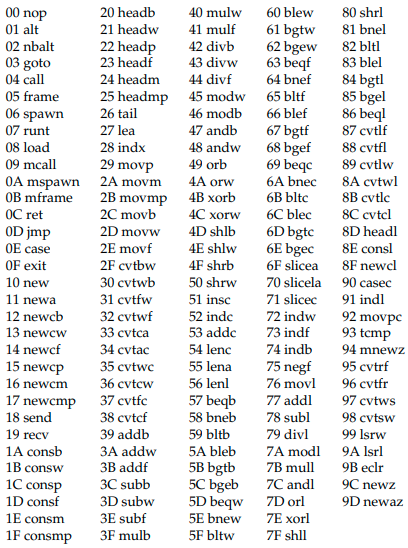
The address_mode byte specifies the addressing mode of each of the three operands: middle, source and destination. The source and destination operands are encoded by three bits and the middle operand by two bits. The bits are packed as follows:
bit 7 6 5 4 3 2 1 0
m1 m0 s2 s1 s0 d2 d1 d0
The middle operand is encoded as follows:
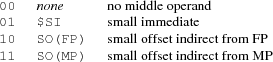
The source and destination operands are encoded as follows:
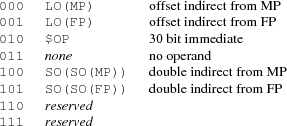
The middle_data field is only present if the middle operand specifier of the address_mode is not ‘none’. If the field is present it is encoded as an OP.
The source_data and dest_data fields are present only if the corresponding address_mode field is not ‘none’. For offset indirect and immediate modes the field contains a single OP. For double indirect modes the values are encoded as two OP values: the first value is the register indirect offset, and the second value is the final indirect offset. The offsets for double indirect addressing cannot be larger than 16 bits.
The Type Section
The type section contains type descriptors describing the layout of pointers within data types. The format of each descriptor is:
Type_descriptor
{
OP: desc_number;
OP: size;
OP: number_ptrs;
array[number_ptrs] of B: map;
};
The desc_number is a small integer index used to identify the descriptor to instructions such as new.
The size field is the size in bytes of the memory described by this type.
The number_ptrs field gives the size in bytes of the map array.
The map array is a bit vector where each bit corresponds to a word in memory. The most significant bit corresponds to the lowest address. For each bit in the map, the word at the corresponding offset in the type is a pointer iff the bit is set to 1.
The Data Section
The data section encodes the contents of the MP data for the module. The section contains a sequence of items; each item contains a control byte and an offset into the section, followed by one or more data items. A control byte of zero marks the end of the data section. Otherwise, it gives the type of data to be loaded and selects between two representations of an item:
Short_item
{
B: code;
OP: offset;
array[code & 16rF] of type[code>>4]: data;
};
Long_item
{
B: code;
OP: count;
OP: offset;
array[ndata] of type[code>>4]: data;
};
A Short_item is generated for 15 or fewer items, otherwise a Long_item is generated. In a Long_item the count field (bottom 4 bits of code) is set to zero and the count follows as an OP. The top 4 bits of code determine the type of the datum. The defined values are:
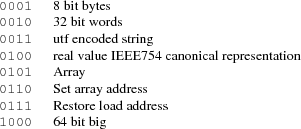
The byte, word, real and big operands are encoded as sequences of bytes (of appropriate length) in big-endian form, converted to native format before being stored in the data space. The ‘string’ code takes a UTF-encoded sequence of count bytes, which is converted to an array of 16-bit Unicode values stored in an implementation-dependent structure on the heap; a 4-byte pointer to the string descriptor is stored in the data space. The ‘array’ code takes two 4-byte operands: the first is the index of the array’s type descriptor in the type section; the second is the length of the array to be created. The result in memory is a 4-byte pointer to an implementation-dependent array descriptor in the heap.
Each item’s data is stored at the address formed by adding the offset in that item to a base address maintained by the loader. Initially that address is the base of the data space of the module instance. A new base for loading subsequent items can be set or restored by the following operations, used to initialize arrays. The ‘set array index’ item must appear immediately following an ‘array’ item. Its operand is a 4-byte big-endian integer that gives an index into that array, at which address subsequent data should be loaded; the previous load address is stacked internally. Subsequent data will be loaded at offsets from the new base address. The ‘restore load address’ item has no operands; it pops a load address from the internal address stack and makes that the new base address.
The Module Name
The module name immediately follows the data section. It contains the name of the implementation module, in UTF encoding, terminated by a zero byte.
The Link Section
The link section contains an array of external linkage items: the list of functions exported by this module. Each item describes one exported function in the following form:
Linkage_item
{
OP: pc;
OP: desc_number;
W: sig;
array[] of byte: name;
};
The pc is the instruction number of the function’s entry point. The desc_number is the index, in the type section, of the type descriptor for the function’s stack frame. The sig word is a 32-bit hash of the function’s type signature. Finally, the name of the function is stored as a variable length array of bytes in UTF-8 encoding, with the end of the array marked by a zero byte. The names of member functions of an exported adt are qualified by the name of the adt. The next linkage item, if any, follows immediately.
5. Symbol Table File Format
The object file format does not include type information for debuggers. The Limbo compiler can optionally produce a separate symbol table file. Its format is defined in the entry sbl(6) of [1].
6. References
1. Inferno Programmer’s Manual (Third Edition), Volume 1 (‘the manual’), Vita Nuova Holdings Limited, June 2000.
2. P Winterbottom and R Pike, ‘‘The Design of the Inferno Virtual Machine’’, reprinted in this volume.